


Hearing your child speak their first words is one of parenting's most anticipated milestones. Yet, as toddlers grow, it is common for parents to compare their child's language development with peers or older siblings. Questions quickly arise: "Why isn't my 2-year-old combining words yet?" or "Is it normal that only family members understand what my toddler says?"
While variations in timeline are natural, waiting too long under the assumption that a child will "just grow out of it" can cause avoidable developmental and emotional hurdles. Understanding the difference between normal progress and true speech delays is the first step toward unlocking your child's communication.
Speech Delay vs. Language Delay: What Is the Difference?
Though often used interchangeably, speech and language are distinct clinical facets:
- Speech: Refers to the physical verbal production of sounds and words. It involves articulation (forming phonemes), voice tone, and fluency. A child with a speech delay might understand everything but struggle to physically articulate words clearly.
- Language: Refers to the broader system of understanding (receptive language) and expressing thoughts (expressive language). A child with a language delay might pronounce words clearly but only be able to string together very basic two-word phrases, or struggle to understand questions.
Critical Step: Always Check Hearing First
Children learn to produce speech by listening to the sounds around them. Frequent middle ear infections, silent fluid build-up behind the eardrum, or undiagnosed hearing loss can muffle sounds, directly causing articulation delays. A comprehensive audiology screening is always the primary step in evaluating speech delays.
Age-by-Age Developmental Milestones
Here is a general timeline of what speech-language pathologists look for in early childhood:
Typical Communication Milestones
- By 12 Months: Responds to their name, uses gestures (waving "bye-bye", pointing to desired toys), and produces variegated babbling ("ba-ba", "ma-ma", "da-da").
- By 18 Months: Uses at least 10 to 20 consistent single words, imitates vocalizations, and identifies simple objects or body parts when asked.
- By 24 Months: Has an expressive vocabulary of 50+ words, begins combining two words spontaneously ("more milk", "go park"), and understands two-step commands ("pick up the ball and give it to mommy").
- By 36 Months: Uses 3-to-4-word sentences, asks "what" or "why" questions, and is understood by familiar caregivers at least 75% of the time.
Red Flags That Warrant Immediate Professional Support
If you observe any of the following signs, an evaluation with a pediatric speech-language pathologist is strongly recommended:
- Lack of gestures like pointing or waving by 12–15 months
- Loss of previously acquired speech or babbling skills at any age
- Not responding to their name or familiar sounds by 12 months
- Inability to imitate words or vocal sounds by 18 months
- Excessive frustration, tantrums, or distress caused by inability to communicate basic needs
- Unclear speech that cannot be understood by family members after age 2.5
How Speech Therapy Works at Sprouting Bloom
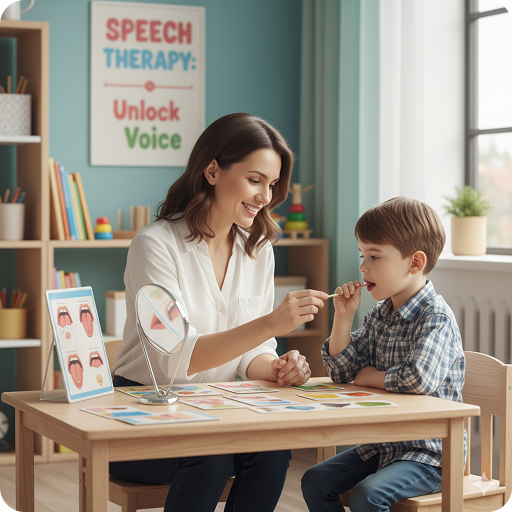
At Sprouting Bloom's centers in Howrah and Dum Dum, speech-language therapy is engaging, child-friendly, and naturalistic. We use interactive toys, musical cues, picture exchange systems (PECS), and oral-motor sensory games to stimulate vocalization without creating anxiety.
Equally important, our speech pathologists train parents with practical conversational techniques to turn daily routines—like bath time, grocery shopping, and bedtime reading—into rich, low-stress language laboratories.
How Parents Can Encourage Speech at Home
- Get on Eye Level: Sit face-to-face so your child can watch your lips, tongue, and facial expressions when you talk.
- Narrate Your Day: Talk through what you are doing in simple sentences: "Mommy is cutting the apple. Red sweet apple!"
- Read Books Interactatively: Don't just read the words; point to pictures, make funny animal noises, and ask open-ended questions.
- Limit Passive Screen Time: Passive screen consumption reduces organic back-and-forth communicative exchanges essential for language acquisition.